Quoted in PrintAction
How does a print shop get found in AI search?
Last updated
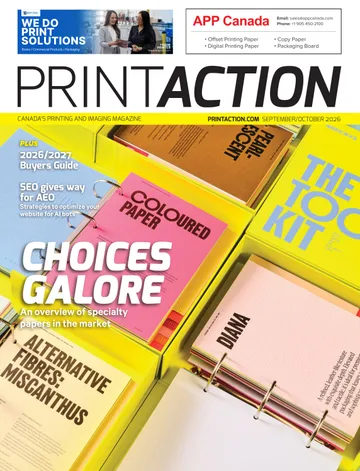
As quoted in "Make sure you are found in AI searches" by Treena Hein, pages 14 to 16. Read the full article on Issuu
Short answer
A print shop gets found in AI search by answering the questions its buyers actually ask, in their own words and with their numbers in them, on a separate page for each service it really offers. Keep the facts that change current, new equipment above all, and make sure your template is not stamping every page with a fresh date it has not earned. Measure before and after: the same 20 questions, two assistants, once a month. I gave a shorter version of this advice to PrintAction for its September/October 2026 issue.
Where does a print shop start?
With a measurement, before anyone rewrites a page. List the 20 questions customers ask you most often. Once a month, put every one of them to two AI assistants, and record in a spreadsheet whether your shop gets named and which shops get named instead.
Monthly, because one round tells you almost nothing. These systems do not give the same answer twice: in Thinking Machines Lab's Defeating Nondeterminism in LLM Inference, one prompt run 1,000 times, with the settings pinned as tight as they go, came back as 80 different answers. A single check is a coin toss. An hour a month, kept up, shows you a trend.
The same spreadsheet tells you later whether paying anyone made a difference. Outside help earns its keep when you cannot get into your own site and someone has to deal with whoever controls the template, and when the problem is off your site, which is most of it. Otherwise the list on this page is the work.
Which questions should the website answer?
The ones your buyers already ask, in the words they use. As I put it in PrintAction: "Open the last 40 quote requests and voicemails, and write each question down in the customer's words, including the wrong words they used."
Keep the wrong words. Your team says saddle stitch; plenty of customers ask for booklets stapled in the middle. An assistant answers from pages that use the customer's phrase, so both phrasings belong on your page.
Keep the numbers too. Buyers rarely ask whether you do colour matching. They name a Pantone colour and a paper, give a quantity and a date, and ask whether you can run variable data. A page that answers at that level of detail is a page an assistant can use.
Do not start with a staff meeting. Staff remember the questions they enjoy answering, and the customer's own wording is exactly what never comes up in a meeting.
What should the pages look like?
One page for each thing you actually sell. Large-format banners, perfect-bound books, labels: each gets its own page saying what you run it on, which stocks you carry, your minimums and your turnaround, written by the person on your floor who does that job. A row of equipment brand logos and the words fast and high quality is what every shop says, and it answers nothing.
A few pages like that do more than a long run of near-identical pages that only swap the city name.
Choose the questions for buyers, not for the search results layout. Google stopped showing FAQ rich results in Search on 7 May 2026, so there is no dropdown under your listing to fill any more. The text still counts, because assistants read page copy when they decide which shop to name.
How often should a print shop update its website?
When a fact changes, not on a calendar. Hours and contact details the same day. New equipment the week it is installed, and that is the one most shops miss: "Equipment is the fact that changes most and gets updated least." A new press or finishing line changes what you can quote for, buyers ask about it, and it tends to stay off the website for months.
Before you set any schedule, check the dates your site already shows. Many templates and supplier-built platforms rewrite the last-modified date on every page whenever anything on the site is republished, so pages nobody has touched in a year claim to be new. Google's guidance on helpful content asks whether dates are changed to make pages seem fresh. Open your sitemap and look at the dates beside pages you know are old. If they all say last week, your template is doing it. That check takes ten minutes and is worth more than any publishing calendar.
What helps beyond your own website?
Other sites mentioning you. Assistants lean far more on what other sites say about you than on what you say about yourself, and a print shop has more of these mentions within reach than almost any local trade, because it manufactures other organisations' marketing.
- Ask for the credit on what you print. The festival program, the association directory, the arena signage: every one of those organisations has a website. A line in the credits and a link on the event page cost nothing but the asking.
- If your site is locked, your listings are your structured data. On a franchise or supplier template you cannot get into, your Google Business Profile, chamber of commerce entry and industry association listings do the same job in someone else's code.
- Reply to reviews. Mostly because each reply is more text about your work, in a customer's words.
This kind of work rewards the smaller shop. In an academic benchmark (Aggarwal et al., "GEO: Generative Engine Optimization", KDD '24, Table 2, the Cite Sources row), run against a test model built on an older language model rather than a live assistant, adding citations lifted the visibility score by 115% for a site sitting fifth and cut it by 30% for the site already sitting first. The tactics work hardest for whoever is currently losing, which for once is the independent shop rather than the chain.
What about structured data and sitemaps?
Structured data is underused for a boring reason: nothing visible changes, so it loses every argument against work you can see. For a single location it is about an afternoon.
The code has to match the page. Google's structured data guidelines require markup to be a true representation of what a visitor sees, and a mismatch can cost a page its rich results. If the code still promises same-day business cards you stopped offering two years ago, that is the mismatch. Google's Rich Results Test covers only the types Google itself displays, validator.schema.org checks the code itself, and both are free.
A sitemap helps a crawler find your pages. It has never persuaded anything to recommend you.
As quoted in PrintAction (Sept/Oct 2026, pp. 14-16)
The two printed lines quoted above, on customers' questions and on equipment, are from "Make sure you are found in AI searches", subtitled "Tips to increase your visibility among chatbots", an article by Treena Hein in PrintAction, Canada's printing and imaging magazine, published by Annex Business Media. It ran in the Technology section of the September/October 2026 issue. I am quoted as founder of Ainora in Lithuania, one of several experts in the piece.
Everything else on this page is my own advice in my own words, written for this site. It is not the article and does not stand in for it.
| Detail | PrintAction, September/October 2026 |
|---|---|
| Publication | PrintAction, published by Annex Business Media |
| Issue | September/October 2026, Vol. 66, No. 5 |
| Article | "Make sure you are found in AI searches" |
| Author | Treena Hein |
| Section and pages | Technology, pages 14 to 16 |
| Quoted as | Justas Butkus, founder of Ainora in Lithuania |
Read the full article in the September/October 2026 issue on Issuu, pages 14 to 16, or through PrintAction's digital editions. There is no standalone web version of the article yet; this page will link to it when there is.
Frequently asked questions
Was Justas Butkus quoted in PrintAction?
Yes. Justas Butkus, founder of Ainora in Lithuania, is quoted in "Make sure you are found in AI searches" by Treena Hein, in PrintAction's September/October 2026 issue (Vol. 66, No. 5), pages 14 to 16. He is one of several experts quoted in the article, which is read in the issue on Issuu.
Can I read the PrintAction article on this page?
No. The article belongs to PrintAction and its publisher, Annex Business Media, and is read in the September/October 2026 issue on Issuu, pages 14 to 16. This page is Justas Butkus's own advice on the same subject, quoting two short lines from it.
What is the first thing a print shop should do to show up in AI search?
Measure where it stands: put the 20 questions customers ask most to two AI assistants and note who gets named. Then collect the real questions from recent quote requests and voicemails, in the customers' own phrasing, mistakes and numbers included, and answer them on the site.
How often should a print shop update its website for AI search?
Whenever a fact changes: hours and contact details the same day, new equipment the week it is installed. Before setting any schedule, check whether the site template rewrites every page's last-modified date on each republish, because that makes the whole site look falsely fresh.
How do I know whether AI assistants recommend my print shop?
Put the same 20 customer questions to two AI assistants once a month and log in a spreadsheet how often your shop is named and who is named instead. Answers change from run to run, so one check tells you little; the trend over months is what to watch.
Justas Butkus is the founder of Ainora (AINORA, MB), a Lithuanian company based in Vilnius that builds AI voice agents and works on how AI systems decide which businesses to recommend. He was quoted in PrintAction's September/October 2026 issue on how print shops get found in AI search.
If you want to know whether assistants name your shop
Send the questions your customers ask most, and your website. That is usually enough to see where the gaps are.